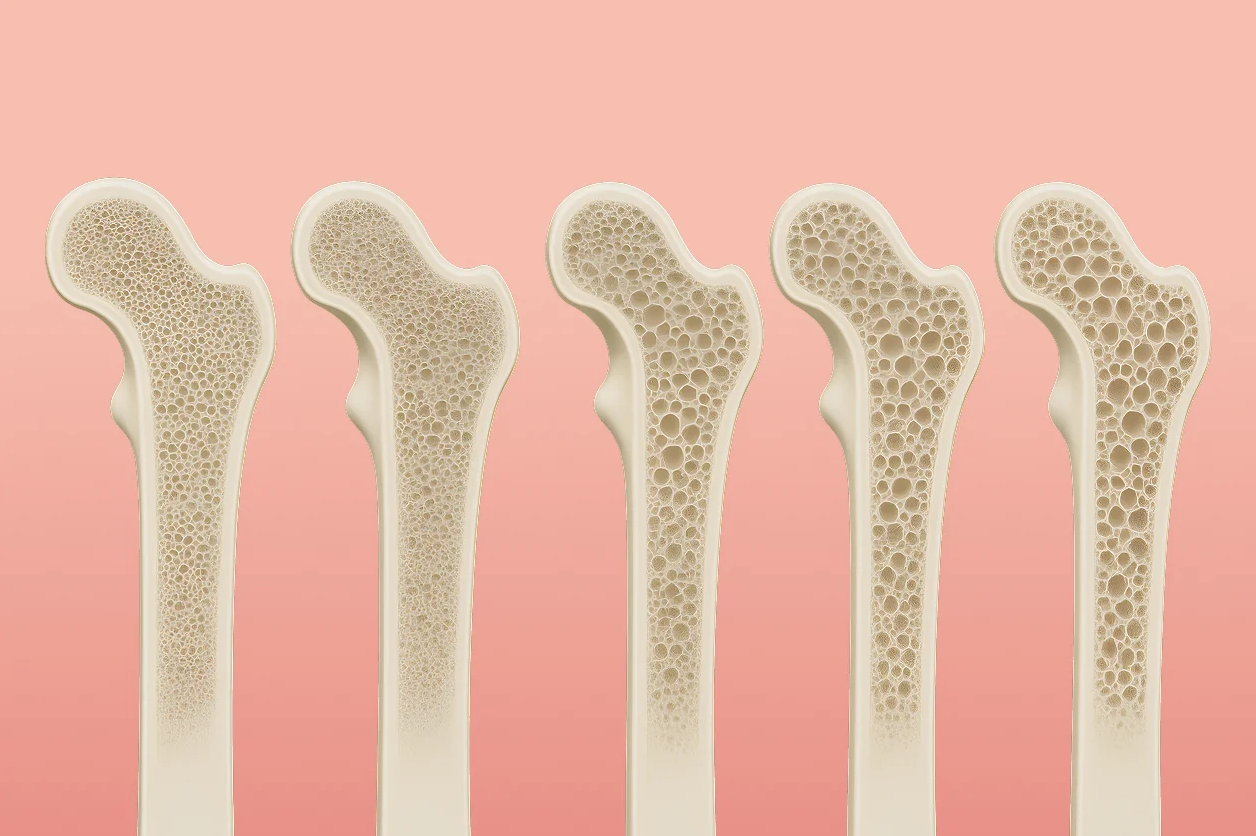
Osteoporosis isn’t a disease of old age. At its core, it’s a disease of the menopause transition that simply takes decades to announce itself. The bone you lose in your late forties and early fifties is the bone you don’t have at seventy, and by the time a fracture makes the diagnosis for you, the most protective window has already closed.
September is Menopause Awareness Month, and bone health is the part of the conversation that gets the least airtime. Hot flashes get attention because you feel them. Bone loss gets ignored because you don’t. In the United States, about 1 in 2 women over age 50 will break a bone because of osteoporosis, and most of them had no idea their bone density was low until it happened.
Here’s what’s actually going on, what we check at our Fort Worth office, and what you can do now that genuinely changes the outcome.
Why Menopause Hits Bone So Hard
Bone is living tissue. It’s constantly being broken down and rebuilt, and estrogen is one of the main brakes on the breakdown side of that cycle. When estrogen drops, the brake comes off, and breakdown outpaces rebuilding.
The timing is sharper than most women expect.
- The fastest loss starts before your last period.
- Bone loss accelerates roughly one year before your final menstrual period and stays rapid for about two to three years after it. This means it’s well underway while you’re still having cycles and may not consider yourself “in menopause” yet.
- The rate during that window is significant.
- Women lose an average of around 2 percent per year at the spine during this phase, with somewhat slower loss at the hip. Overall, many women lose up to 20 percent of their bone density in the five to seven years surrounding menopause.
- Then it slows, but it doesn’t stop.
- After the rapid phase, loss settles to roughly 0.5 percent per year. That’s a slower leak, but it continues for the rest of your life, on top of whatever you already lost.
The practical takeaway: the years you’re most likely to dismiss as “just perimenopause” are the years doing the most damage.
Who Needs a Bone Density Scan, and When
A DXA scan (dual-energy X-ray absorptiometry) is a quick, low-radiation scan of your hip and spine. It’s painless, takes about 10 to 15 minutes, and you stay fully clothed.
- Age 65 for most women.
- ACOG recommends bone density screening for all postmenopausal women 65 and older.
- Earlier if you have risk factors.
- For postmenopausal women under 65, screening is used selectively when significant risk factors are present. Those include a prior fracture from a minor fall after age 50, a parent who fractured a hip, low body weight, current smoking, three or more alcoholic drinks a day, long-term steroid use (three months or more), rheumatoid arthritis, and certain medications such as aromatase inhibitors after breast cancer.
- Early menopause counts.
- If your periods stopped before age 45, whether naturally, from primary ovarian insufficiency, or after surgical removal of the ovaries, you spent extra years without estrogen’s protection. That’s a real risk factor, and it’s worth raising with us directly.
- How the results read.
- Your score is reported as a T-score. Above -1.0 is normal. -1.0 to -2.5 is low bone mass (osteopenia). -2.5 or lower is osteoporosis. A number in the middle range isn’t a diagnosis, it’s information you can still act on.
- How often to repeat it.
- Without new risk factors, DXA generally shouldn’t be repeated more often than every 2 years.
We also use a tool called FRAX, which combines your bone density with your personal risk factors to estimate your 10-year probability of a major fracture. It’s often what determines whether low bone mass warrants treatment or just monitoring.
What Actually Protects Bone
- Resistance training, not just walking.
- Bone responds to load. Walking is excellent for your heart and does relatively little for your spine and hip density. Progressive resistance training two to three times a week, working the major muscle groups with weight heavy enough to be challenging, is the exercise with the strongest evidence behind it. Impact work like hopping or stair climbing adds benefit for women whose bones can safely tolerate it.
- Calcium from food first.
- Women 51 and older need about 1,200 mg of calcium per day from all sources combined. Food sources absorb better and carry fewer downsides than supplements. If you’re falling short, supplement the gap rather than the whole amount, and split doses, since your body absorbs roughly 500 mg at a time.
- Vitamin D, 800 to 1,000 IU daily.
- This is the standard recommendation for adults 50 and older. Without adequate vitamin D, you don’t absorb the calcium you’re eating.
- Protein at every meal.
- Bone is about half protein by volume. Adequate protein also protects the muscle mass that keeps you steady on your feet, and most fractures happen because of a fall.
- Balance and fall prevention.
- A hip fracture requires two things: fragile bone and a fall. Balance work, a vision check, a look at any medication that causes dizziness, and clearing the rug at the top of your stairs all count as bone care.
- Stop smoking, and cap alcohol.
- Smoking directly accelerates bone loss. Three or more drinks a day is an independent fracture risk factor.
Where Hormone Therapy Fits
Several systemic menopausal hormone therapy products are FDA-approved for the prevention of postmenopausal osteoporosis, and hormone therapy started near the time of menopause meaningfully reduces fracture risk.
For years, the conversation was shut down by a boxed warning on the label. In November 2025, the FDA removed those boxed warnings from menopausal hormone therapy products after a full scientific re-review. If you were told a decade ago that hormone therapy wasn’t an option for you, that decision was made with different information than we have now.
Hormone therapy isn’t right for everyone, and bone protection alone isn’t usually the reason to start it. But if you’re also dealing with hot flashes, sleep disruption, or genitourinary symptoms, and you’re within about 10 years of your final period, it’s a conversation worth having rather than assuming the answer.
For women who need bone-specific treatment, there are also effective non-hormonal medications. Low bone density is one of the most treatable findings we hand you.
When to Call Us
- You’ve broken a bone from a minor fall after age 50, at any bone site.
- You’ve lost height, particularly 1.5 inches or more from your tallest adult height.
- Your periods stopped before 45, for any reason.
- You’re on long-term steroids or an aromatase inhibitor.
- You’re approaching or past 65 and have never had a DXA scan.
- You’re in perimenopause now and want to know your baseline while you can still act on it.
Bone loss is silent, but it isn’t inevitable, and it isn’t irreversible in the way most women assume. The women who do best are the ones who get a number in their forties or fifties instead of waiting for a break in their seventies.
You’ve got this!
If you have any concerns or questions about bone health after menopause, feel free to reach out to us. We’re here to support you every step of the way.