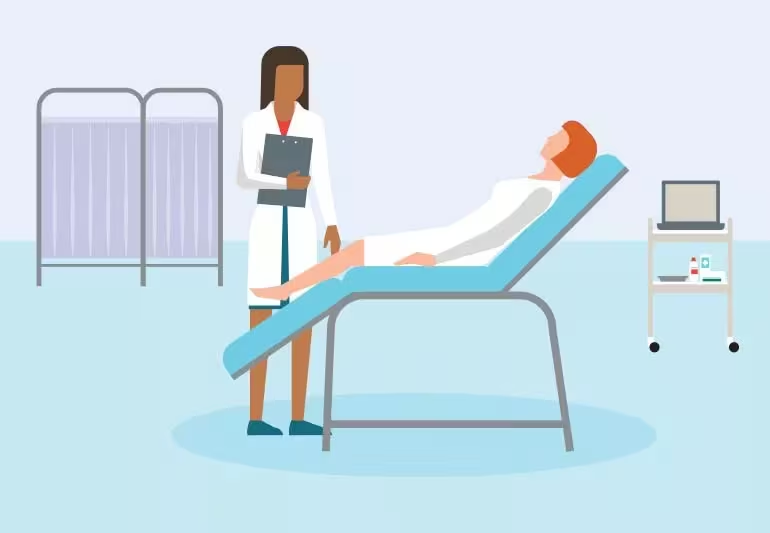
If you’ve been quietly skipping your annual visit because you “don’t need a Pap this year,” we need to have a conversation. The well-woman exam stopped being a yearly Pap smear over a decade ago, and yet that misconception is still the single most common reason patients tell us they put off coming in.
May is Women’s Health Month, and the well-woman visit is the one appointment built around the whole picture of you, not a single test. Here’s what actually happens at a FĒNOM well-woman exam in Fort Worth, what gets screened at what age, and why this visit is still very much worth your time even when there’s no swab involved.
What Actually Happens at a Well-Woman Visit
A well-woman exam is a comprehensive preventive visit. It’s not one test, it’s a structured look at the systems that change most across a woman’s life, plus the conversations that don’t happen anywhere else in healthcare.
A typical FĒNOM well-woman visit includes:
- A focused health update.
- Review of your medical and family history, any new symptoms, medications, sleep, mood, stress, alcohol and tobacco use, intimate partner safety, and reproductive plans. This is usually the most valuable 10 minutes of the visit.
- Vital signs and physical assessment.
- Blood pressure, weight, BMI, and a general physical exam. Blood pressure alone is one of the highest-yield screenings in medicine, and we catch new hypertension here all the time.
- A breast assessment.
- A clinical breast exam plus a conversation about your screening plan. Self-awareness (knowing what is normal for your breasts and reporting changes) is now emphasized over rigid monthly self-exams.
- A pelvic exam, when indicated.
- ACOG considers this a shared decision after age 21 in women who are not having symptoms. We may recommend it for cervical screening, for symptom evaluation (pain, bleeding, discharge), or as part of a workup. We do not require it just because the calendar says so.
- Screenings appropriate to your age and risk.
- Counseling and a plan.
- Contraception or pregnancy planning, perimenopause questions, vaccines, mental health, weight and metabolic health, sexual health, bone health, and aesthetics. You leave with a written plan, not a vague “see you next year.”
The Screenings That Change With Age
This is where most patients are surprised. The list is not static. Here’s roughly how it looks across the lifespan, based on current ACOG, USPSTF, and CDC guidance.
- Cervical cancer screening (Pap and HPV).
- Ages 21 to 29, Pap test every 3 years (HPV testing alone can be considered ages 25 to 29). Ages 30 to 65, three options exist, primary HPV testing every 5 years (preferred), co-testing (Pap + HPV) every 5 years, or Pap alone every 3 years. After 65, you may be able to stop if you’ve had adequate negative prior screening. Patient-collected HPV testing is now an option for average-risk patients ages 30 to 65. You do not need a Pap every year.
- Mammography.
- The USPSTF updated its recommendation in 2024 to biennial screening starting at age 40 through age 74. ACOG offers screening annually starting at 40 as a reasonable alternative. We tailor the plan to your personal and family history, breast density, and prior imaging.
- STI screening.
- Annual chlamydia and gonorrhea screening for all sexually active women under 25, and over 25 with risk factors. HIV at least once between ages 13 and 65, and per pregnancy. Syphilis screening has been broadened given a national rise in cases.
- Diabetes, cholesterol, and thyroid.
- Lipid panel typically starting around age 20 and repeated every 4 to 6 years if normal, more often with risk factors. Diabetes screening starting around age 35 (earlier with obesity or family history). Thyroid testing based on symptoms or pregnancy.
- Colorectal cancer screening.
- Starts at age 45 for average-risk patients (USPSTF, 2021). Colonoscopy every 10 years or stool-based tests on shorter intervals are both acceptable.
- Bone density (DXA).
- Routine screening at age 65, earlier with risk factors (low body weight, prior fracture, certain medications, early menopause, family history).
- Vaccines.
- HPV through age 26 (shared decision making 27 to 45), Tdap once and then a Td booster every 10 years, annual influenza, COVID-19 per current guidance, RSV in pregnancy and in older adults, and shingles starting at 50.
What People Get Wrong About the “Pap Smear”
The biggest myth we hear is, “If I don’t need a Pap, I don’t need to come in.” Two reasons that’s not how it works.
- The Pap test screens for one thing. It looks for changes on the cervix that can lead to cervical cancer. It does not screen for ovarian cancer, uterine cancer, breast cancer, STIs, fibroids, endometriosis, or anything else.
- Most of what we catch at a well-woman visit isn’t on a Pap. New high blood pressure, abnormal bleeding patterns, an undiagnosed thyroid issue, a perimenopause workup, a contraception update, a worsening mood symptom, a breast lump. Those don’t wait three years for a Pap to be due.
The Conversations Worth Having, Even If Nothing Feels Wrong
Some of the most useful well-woman visits we do are with patients who tell us, “I’m fine, I’m just here for the checkup.” A few prompts that have led to meaningful changes for patients this year:
- “My cycle is doing something new.”
- “I’m thinking about trying for a baby in the next year.”
- “I haven’t felt like myself and I’m not sure if it’s hormones, sleep, or stress.”
- “I’m interested in body composition tracking or pelvic floor therapy, what would you recommend?”
- “I want to know what I should be screening for at my age.”
If anything on that list sounds familiar, write it down before your appointment. Patients who come in with a short list always get more out of the visit.
When to Schedule
Once a year, every year, even in years when no swab is involved. If you are due for cervical cancer screening, we will fold it into the visit. If you are not, the visit still earns its place. Most insurance plans, including those compliant with the Affordable Care Act, cover the well-woman visit at no out-of-pocket cost.
If it has been more than 12 months since your last visit, this Women’s Health Month is the nudge. Booking the appointment you’ve been putting off is one of the easiest, highest-leverage things you can do for the next decade of your health.
If you have any concerns or questions about your well-woman exam or what screenings make sense at your age, feel free to reach out to us. We’re here to support you every step of the way.